
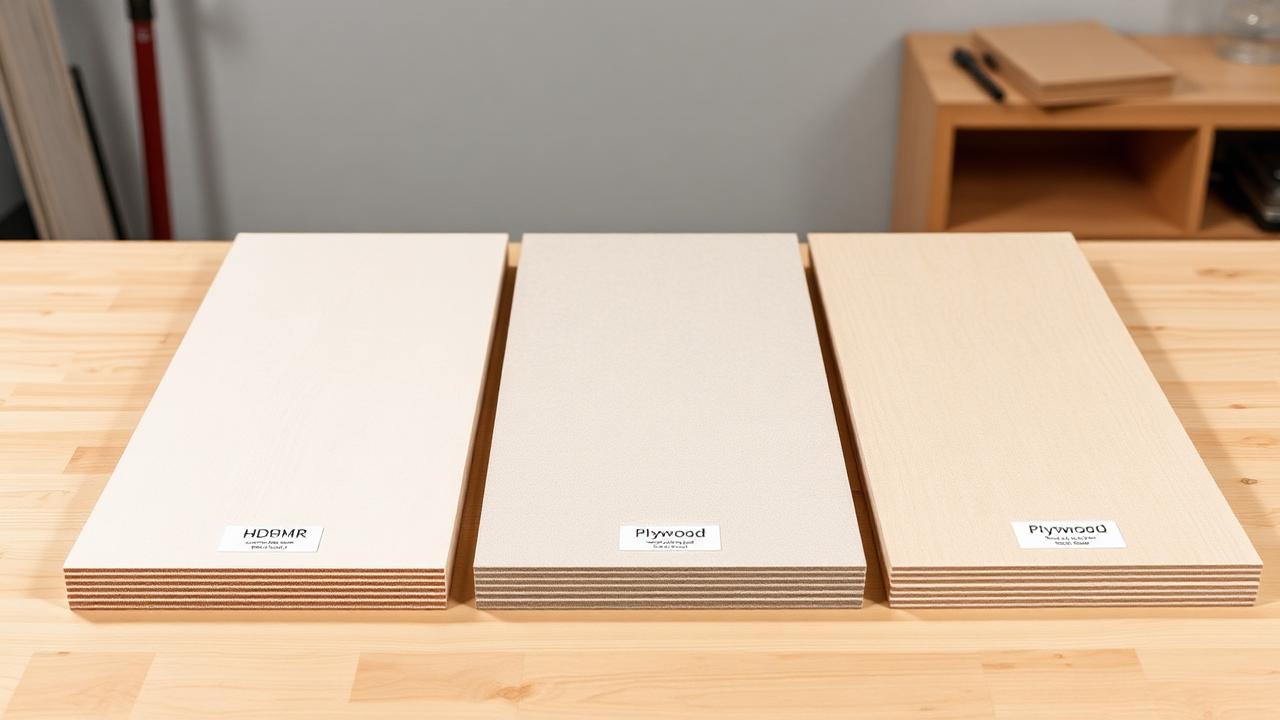
What "carcass" means and why it matters
The carcass is the structural box behind every shutter, drawer, and shelf — the unseen panels that hold your kitchen and wardrobe up. You see the shutter; you live with the carcass. Get the shutter wrong and the kitchen looks dated in five years. Get the carcass wrong and the kitchen falls apart in five years.
In Ghaziabad's climate — peak summer at 45°C, monsoon humidity above 85%, occasional water leaks behind every kitchen sink — the carcass material is the single biggest determinant of how long your modular furniture lasts. Three materials dominate the Indian market: HDHMR, MDF, and plywood. They look almost identical when laminated. They perform very differently over a decade.
The three materials, briefly
MDF (Medium Density Fibreboard) is wood fibres pressed with resin. Density around 600–700 kg/m³. Smooth, easy to paint, cheapest of the three. Standard MDF absorbs water and swells. Moisture-resistant variants exist (HDF-HMR, "Boilo") but cost more and still aren't true HDHMR.
Plywood is thin wood veneers cross-laminated with adhesive. Strength varies dramatically by grade: MR (moisture resistant) is for dry interiors; BWR (boiling water resistant) handles occasional moisture; BWP/marine grade is fully water-resistant and used in kitchens, bathrooms, and coastal homes.
HDHMR (High Density High Moisture Resistant board) is hardwood fibres compressed with moisture-resistant resin under high pressure. Density around 800–900 kg/m³ — significantly higher than MDF. The same uniform composition as MDF but with water-resistant resin and substantially better mechanical properties. Often described as "MDF that performs like marine ply."
Side-by-side comparison
| Factor | MDF (standard) | HDHMR 18mm | BWP marine ply |
|---|---|---|---|
| Density | 600–700 kg/m³ | 800–900 kg/m³ | 600–700 kg/m³ |
| Water resistance | Poor — swells in humidity | Excellent — designed for kitchens/bathrooms | Excellent — fully waterproof glue |
| Screw holding | Weak — strips under load | Strong — ~10× MDF | Strongest — cross-grain layers |
| Edge finish (cut surface) | Smooth, uniform | Smooth, uniform | Visible plies, needs edge banding |
| Termite resistance | Low | High (resin content) | Medium (depends on treatment) |
| Lifespan in NCR climate | 5–7 years | 12–15 years | 15–20 years |
| Cost per sq ft (2026) | ₹40–70 | ₹110–160 | ₹140–220 |
| Best for | Decorative panels, dry interiors | Kitchens, wardrobes, humid zones | Kitchens, bathrooms, structural |
| Worst for | Anything that meets water | Outdoor unsealed | Visible cut edges (needs banding) |
Why MDF fails in Ghaziabad
In Pune, Bangalore, or Kolkata, standard MDF can survive a decade in a dry bedroom wardrobe. In Ghaziabad, it doesn't.
The problem is monsoon humidity combined with daily kitchen moisture. From mid-June through mid-September, ambient humidity in NCR sits between 75% and 95%. Standard MDF, even sealed with laminate, gradually absorbs moisture through every micro-gap — exposed cut edges, screw holes, hinge mortises. The fibreboard core swells, the laminate skin starts lifting, and the kitchen base cabinet that was tight in year one starts looking soft and bulged by year three.
The visible failure mode is base swelling. Open the cabinet under your sink in a 5-year-old MDF kitchen and you'll see the lower 4–6 inches of the side panel discoloured, soft, and slightly bowed outward. By year seven, that cabinet typically needs replacement.
This is why no reputable Ghaziabad manufacturer offers MDF as the standard package carcass. If a quote says "MDF" with a straight face for a kitchen, the price is being kept artificially low.
HDHMR — the practical default for Ghaziabad
HDHMR 18mm has become the de facto standard for modular kitchens and wardrobes across mid-tier and premium Indian manufacturers in the last 5 years. The reasons are practical:
- It performs like marine ply at lower cost. HDHMR sits at ₹110–160/sq ft. BWP marine ply is ₹140–220/sq ft. For a 70 sq ft kitchen, that's a ₹4,000–6,000 saving on raw material with no meaningful difference in 12-year performance.
- The cut edge is uniform. Unlike plywood, HDHMR has no visible grain lines or core voids on the cut edge, so the edge banding sits cleaner and lasts longer.
- Screw retention is excellent. Hinges and drawer channels stay tight under daily use. Plywood screws marginally better at the very edges, but HDHMR is more consistent across the panel.
- Termite resistance is built in. The resin content of HDHMR makes it inhospitable to termites without additional treatment.
- Density supports clean finishes. The smoother surface accepts laminate, acrylic, PU, and veneer with fewer surface imperfections.
ModuCrafts uses Action Tesa or Greenply HDHMR 18mm as carcass standard across Budget, Standard, and Premium packages. The carcass doesn't change between tiers — the shutter, hardware, and countertop do.
When BWP marine ply is the better answer
A few situations where BWP plywood remains the right call:
- Wet-zone bathroom vanities. A vanity directly below a sink, where standing water is a real risk over 15 years, benefits from plywood's 100% waterproof glue. HDHMR is moisture-resistant, not waterproof.
- Heavy-load shelving and structural elements. Long open shelves carrying heavy crockery or books, or partition panels carrying hanging cabinets, benefit from plywood's higher flexural strength.
- Coastal NCR homes. Homes very close to water bodies or with chronic seepage problems benefit from BWP plywood's edge water resistance.
- Custom-shaped pieces with visible bevelled edges. When the cut edge will be visible without banding (rare in modular work, common in carpenter-led custom pieces), plywood's natural ply lines can be a design feature.
For a standard Ghaziabad apartment kitchen, HDHMR is the right choice. BWP plywood is an upgrade option, not a default.
How to verify what you're actually getting
This is where most quotes fail buyers. Three things to check:
- Brand stamp on the board. Reputable HDHMR comes from Action Tesa, Greenply, Century, Rushil, Merino, or Crossbond. The brand mark is printed on the back of every full sheet. Ask your manufacturer to show you a stamped board before production. If they can't, you're not getting branded board.
- Thickness verification. 18mm is the carcass standard. Some manufacturers quietly substitute 16mm or 12mm to reduce cost. The difference is invisible once laminated but materially affects strength and lifespan. Slip a measuring tape under a shelf in the showroom kitchen — the panel should measure exactly 18mm.
- Edge banding on every cut. Every exposed edge of every carcass panel — including hidden edges inside cabinets — should be edge-banded with PVC or ABS tape, hot-pressed at the factory. Run your fingernail along an edge inside an open cabinet. If you can feel raw board, the edge is unsealed and will absorb moisture.
How ModuCrafts approaches carcass
Every ModuCrafts kitchen and wardrobe uses HDHMR 18mm carcass from Action Tesa or Greenply, with PVC edge banding hot-pressed on all six surfaces of every panel — including hidden edges. The brand stamp is visible on every sheet that arrives at our factory. We don't quote MDF for any kitchen, wardrobe, or floor-touching unit, regardless of budget tier — in Ghaziabad's climate, MDF cabinets just don't last.
For clients who specifically request BWP marine ply (typically for bathroom vanities or heavy-load shelving), we offer it as a paid upgrade with a fixed price differential, not a vague upcharge.
Want to spec the right carcass?
Talk to ModuCrafts about your kitchen or wardrobe.
We'll walk you through HDHMR vs BWP marine ply for your specific space, with brand stamps you can see and a fixed quote.
Plot 2A, Gangapuram Colony, Hapur Road, Ghaziabad – 201015 · Mon–Sat, 10 AM – 6 PM