
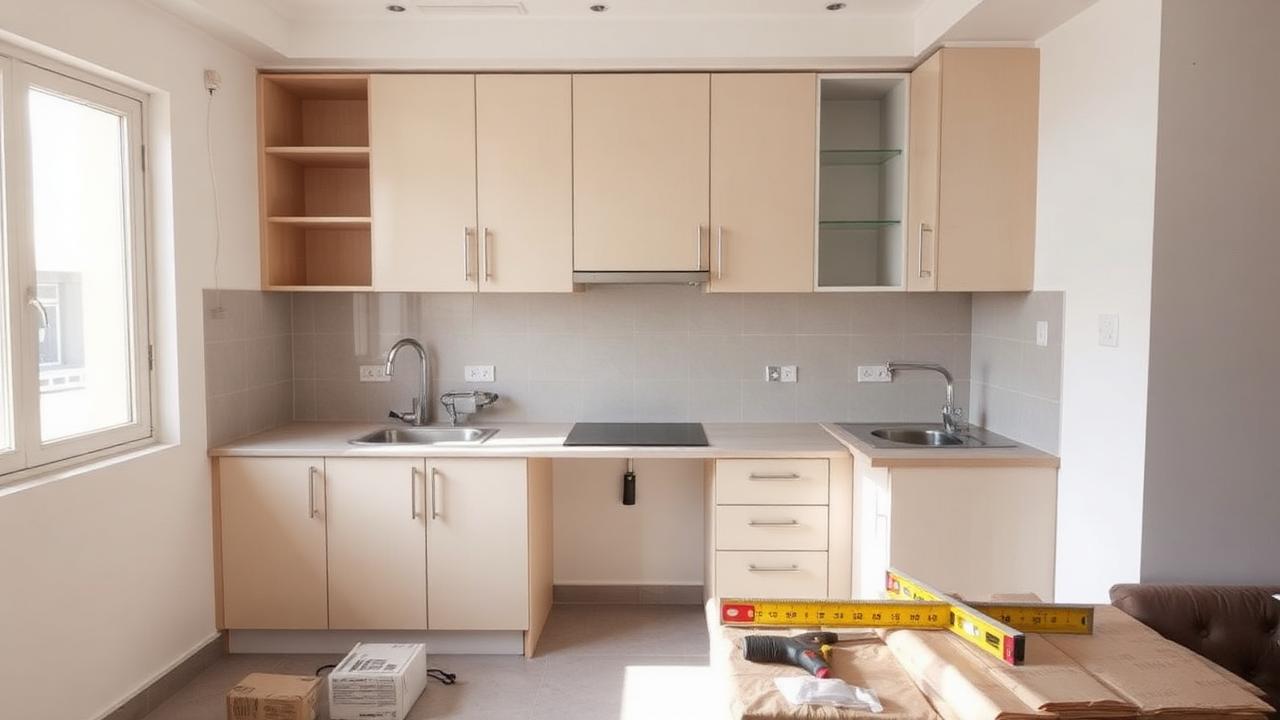
Why this matters before you sign
Most homeowners focus on design and pricing, then assume the install will "just happen." It does — but the days surrounding installation are when things either go smoothly or go wrong, and a homeowner who knows what to expect catches problems early.
Knowing the process also helps you tell a real install team from a careless one. A factory team that walks in with a punch list, dust sheets, and a torque driver is a different operation from two carpenters with a hammer and a measuring tape.
What happens before installation day
The 2–4 days at your home are the visible part. Behind them sits 4–6 weeks of work that determines whether the installation goes well.
- Week 1 — Design and 3D. Site visit, measurements, brief, 3D rendering, material selection. You sign off on the 3D before any factory work begins.
- Week 2 — Material selection and price lock. Carcass, shutter, hardware, countertop, accessories all confirmed. Final fixed price agreed. Production payment cleared.
- Weeks 3–4 — Factory production. CNC cutting of every panel, edge banding on all six surfaces, dry assembly at the factory, quality check, hardware fitting where applicable. Every cabinet is assembled, inspected, then disassembled into transportable modules.
- Week 5 — Pre-installation site check. A site supervisor visits 2–3 days before installation to verify civil work is complete, walls are plumb, electrical and plumbing points are correctly positioned, and the room is ready.
- Days before install: You clear the kitchen completely and protect adjacent rooms. The install team should provide dust sheets and floor protection.
The seven on-site installation stages
Stage 1 — Site readiness check (Day 1, morning)
The install supervisor walks the room with the homeowner and confirms: walls are plumb, floor is level (or noted for filler adjustment), all plumbing points (hot/cold water, drain) are in correct positions, all electrical points (chimney, hob ignition, oven, lights, sockets) are correctly placed, and there's no civil work pending.
If any item fails the check, it's better to delay 1–2 days than to install around it. A misplaced electrical socket discovered after cabinet installation costs three times more to fix.
Stage 2 — Base cabinet installation (Day 1)
Base cabinets are positioned, levelled, and mechanically fixed to the wall and to each other. Levelling is critical — a base out by 3mm at one end will create a gap of 5–6mm by the other end of an L-shape kitchen. Adjustable legs are used to fine-tune levelling on uneven floors.
The cabinets are bolted to each other (not just placed side by side) so the entire run behaves as a single rigid unit. Wall fixings use heavy-duty masonry anchors, not standard screws.
Stage 3 — Wall cabinet mounting (Day 1–2)
Wall cabinets are hung on a continuous metal rail or individual wall plates, fixed into the masonry with heavy anchors. Levelling here is even more critical because wall cabinet height visually amplifies any tilt.
If the kitchen has tall units (pantry, oven housing, broom unit), they're installed at this stage. Tall units are anchored to both the wall and the floor for stability.
Stage 4 — Countertop fitting (Day 2)
Quartz, granite, or engineered stone slab is brought to site, measured against the installed base, and cut to fit. Cutouts for sink, hob, and any tap holes are made on site. The countertop is then placed on the base, levelled, and adhered with structural silicone.
This is the dustiest stage. A good install team uses water-cooled cutting and a vacuum to manage dust. Adjacent rooms should remain protected.
Stage 5 — Shutter alignment (Day 2–3)
Shutters are mounted on hinges and aligned. This is where craftsmanship shows. A professional install team uses three-axis adjustable hinges to align every shutter so all gaps are uniform — typically 2mm — both vertically and horizontally. Misaligned shutters are the most visible installation defect; a professional kitchen has consistent gap lines across the entire elevation.
Stage 6 — Hardware and accessories (Day 3)
Drawers are slotted in and adjusted. Pull-outs, magic corners, tall unit baskets, cutlery trays, and any specialised accessories are installed. Soft-close mechanisms are tested. LED strips and lighting wiring are connected.
Stage 7 — Snagging walkthrough (Day 3 or 4)
The install supervisor walks the finished kitchen with the homeowner. Every drawer, every shutter, every hardware piece is operated and inspected. Any defects (a loose handle, an uneven gap, a dent on a panel, a malfunctioning soft-close) are listed on a snagging sheet.
The snagging is then resolved within 2–7 days — most items same day, some requiring a return visit. The kitchen is officially handed over only after all snagging items close, the warranty document is signed, and the care guide is delivered.
What you should do during installation
- Stay accessible by phone. Decisions occasionally need to be made — "this socket is 4 inches from the planned position; do we adjust the cabinet or relocate the socket?" — and quick answers prevent delays.
- Don't crowd the work. Installation is precise work. Hovering slows the team. A daily 15-minute walkthrough at the end of the day is enough.
- Note anything that bothers you. If a shutter looks slightly off or a gap looks uneven, raise it immediately. Most issues are easier to fix during install than after handover.
- Don't accept rushed snagging. "We'll send someone next week to fix that" is the most common way snagging items disappear. Get specific dates and stick to them.
Common installation issues and how a good team handles them
Walls that are slightly out of plumb. Common in older Ghaziabad construction. A good install team uses scribe panels and adjustable fillers to absorb the wall variation invisibly. A careless team forces the cabinets in, leaving visible gaps.
Floor that slopes. Very common in 5+ year old apartments. Adjustable legs accommodate up to 30mm of variation; beyond that, the install team should advise filler panels at the base.
Electrical or plumbing points slightly off. A 25–50mm misalignment is usually solvable by repositioning the cabinet or cutting an access hole in the back panel. Larger misalignments need civil work.
Damaged panel discovered during install. Should be replaced, not patched. A reputable manufacturer will fly a replacement panel from the factory within 24–48 hours.
How ModuCrafts handles installation
Every ModuCrafts kitchen is installed by our own team — not subcontracted. A site supervisor visits 2–3 days before installation to verify readiness. The install itself takes 2–4 days for a typical Ghaziabad apartment kitchen. Snagging is documented on a checklist and resolved before final handover. Every kitchen is delivered with a written warranty and a care guide.
Ready to plan your kitchen project?
Talk to ModuCrafts about your installation timeline.
We'll walk you through the full 4–6 week process — from 3D sign-off to handover — for your specific space.
Plot 2A, Gangapuram Colony, Hapur Road, Ghaziabad – 201015 · Mon–Sat, 10 AM – 6 PM