
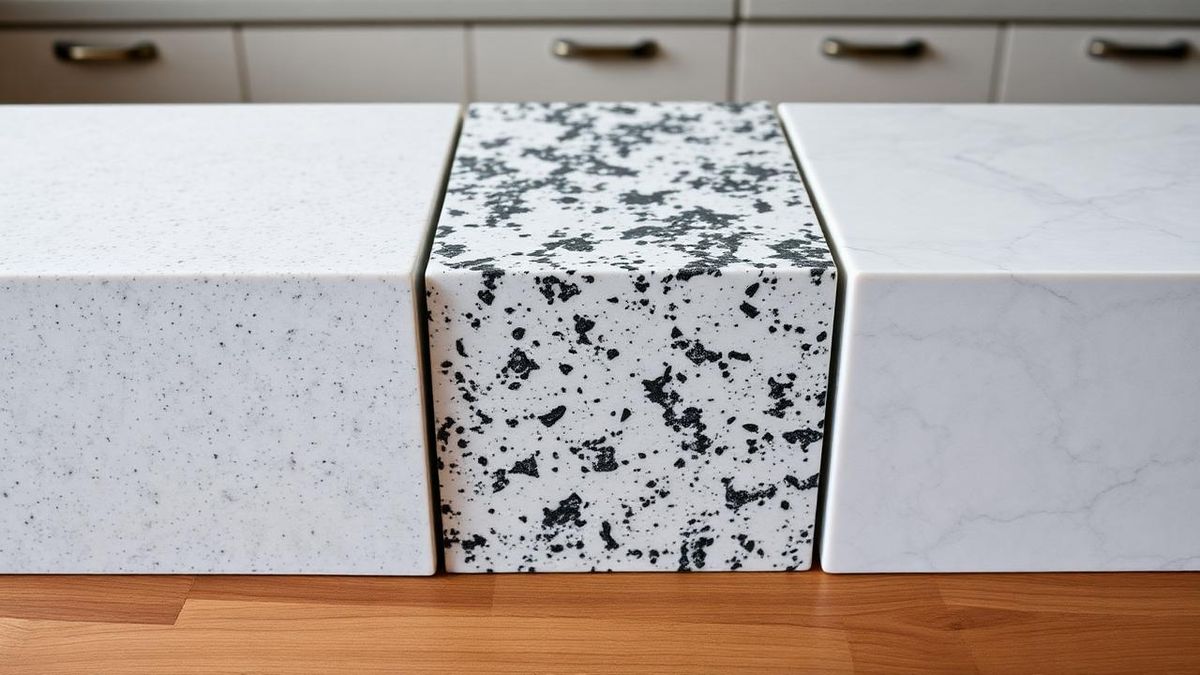
Why countertop choice matters more than you think
The countertop is the most-touched surface in your kitchen. You cut on it, spill on it, put hot pans on it, wipe it down ten times a day. The right countertop disappears into the background of your routine. The wrong one becomes a daily frustration — a stain that won't lift, a chip from a dropped knife, a hot mark from a careless tava.
It's also the single most expensive linear surface in the kitchen. Get it right once and it lasts 15+ years. Get it wrong and you'll either replace it (₹40,000–80,000 for a typical kitchen) or live with it grudgingly.
The four contenders
| Material | Per sq ft (2026, Ghaziabad) | Best feature | Worst feature |
|---|---|---|---|
| Granite | ₹250–550 | Time-tested, durable, hot-pan tolerant | Pattern variation, requires sealing |
| Quartz | ₹450–800 | Consistent, low maintenance, modern | Heat sensitivity, doesn't reseal |
| Marble | ₹400–900 | Stunning natural beauty | Stains, etches, scratches easily |
| Engineered stone (compact / sintered) | ₹800–1,400 | Best overall performance | Highest cost, fewer fabricators |
For a typical 80 sq ft Ghaziabad kitchen countertop area:
- Granite: ₹20,000–44,000
- Quartz: ₹36,000–64,000
- Marble: ₹32,000–72,000
- Engineered stone: ₹64,000–1,12,000
Granite — the practical workhorse
What it is: Natural stone, quarried in slabs, polished to a glossy or honed finish. India is a major granite producer, which keeps domestic prices relatively low.
Why it works: Excellent heat tolerance — you can place a hot tava directly on granite without damage (though it's still not best practice). Very hard, scratch-resistant, knife-tolerant. Tested over decades in Indian kitchens. Natural stone aesthetic with unique veining and patterns. Cost-effective relative to performance.
Where it falls short: Pattern variation between slabs is real — what you see in the showroom isn't exactly what arrives at your kitchen. Granite is porous and requires re-sealing every 1–2 years to prevent oil and turmeric stains from penetrating. Some homeowners find the heavy natural patterning busy in modern minimalist kitchens.
When to choose it: Budget-conscious projects, traditional kitchen aesthetics, or homeowners who want a proven natural stone with the lowest long-term cost. Black galaxy, lakha red, and tan brown granite remain Ghaziabad favourites.
Quartz — the modern default
What it is: Engineered stone made from ~93% natural quartz crystals bonded with resin and pigments. Manufactured in slabs to consistent dimensions and patterns. Top brands: Caesarstone, Silestone, Kalingastone, Quantra.
Why it works: Pattern is consistent across the whole slab and across multiple slabs — what you choose in the showroom is exactly what arrives. Non-porous, so no sealing required, ever. Excellent stain resistance — turmeric, oil, wine, and curry wipe off without trace. Wide range of contemporary colours including pure whites, warm greys, deep blacks, and natural marble-imitations. Dominates 2026 premium kitchen specifications.
Where it falls short: Heat sensitivity is the main caveat. Direct contact with very hot pans (above 150°C) can damage the resin binder, leaving a permanent mark. Always use a trivet for hot tavas. Cost is meaningfully higher than granite. Engineered material doesn't appeal to homeowners who specifically want natural stone variation.
When to choose it: Most premium and aspirational kitchens in 2026. Especially good for modern minimalist aesthetics, light-coloured kitchens where consistency matters, and homeowners who don't want ongoing maintenance.
Marble — beautiful but high-maintenance
What it is: Natural metamorphic stone — limestone recrystallised under heat and pressure. Famous for its veining, depth, and luxury aesthetic.
Why it works: Genuinely stunning, especially for white-veined varieties (Carrara, Calacatta, Statuario). Adds character and a sense of permanence. Cooler to the touch than other surfaces — historically used for pastry work.
Where it falls short: Marble is the softest of the three natural stones. It scratches relatively easily — even sliding a heavy ceramic plate can leave a mark. It etches when exposed to acidic foods (lemon, tomato, vinegar) — the etching is a permanent dulling of the surface that no amount of polishing fully removes. It stains more readily than granite. It requires aggressive sealing (every 6–12 months) and even then, marks accumulate.
For Indian kitchens — where turmeric, ghee, lemon, and tomato are constants — marble is a high-effort choice that very few homeowners maintain well past year three.
When to choose it: Showpiece kitchens where the marble is largely decorative — perhaps an island that doesn't see heavy daily prep, or a feature wall, or a small section of countertop. Or for homeowners who genuinely value the look enough to commit to the maintenance and accept the patina.
Engineered stone — the premium answer
What it is: Sintered stone (Dekton, Neolith, Lapitec) and compact surface materials are next-generation engineered stones, manufactured at very high pressure and temperature. Composition varies — some include natural minerals, glass, and pigments fused into a single ultra-dense slab.
Why it works: Combines quartz's consistency and stain resistance with granite's heat tolerance, and adds UV resistance, scratch resistance, and frost resistance. Available in very thin profiles (4–12mm) for lighter installations. The most visually clean and durable surface available for kitchens. Works for both indoor and outdoor kitchens.
Where it falls short: The most expensive countertop material in the Indian market. Fewer fabricators in Ghaziabad have experience cutting and finishing it, so installation cost adds further. Some thinner slabs require careful handling during transport and install.
When to choose it: Premium and luxury kitchens where budget allows the upgrade. Open-plan kitchen-dining where the countertop is highly visible. Homeowners who want the absolute best performance and are willing to pay for it.
Quick decision matrix
| Your priority | Best choice |
|---|---|
| Lowest cost, proven performance | Granite |
| Most consistent look, lowest maintenance | Quartz |
| Stunning aesthetic, willing to maintain | Marble |
| Best overall performance, premium budget | Engineered stone |
| Modern minimalist kitchen | Quartz or engineered stone |
| Traditional Indian kitchen | Granite |
| Open-plan show kitchen | Engineered stone or premium quartz |
| Heavy daily cooking, multiple cooks | Granite or engineered stone |
Three practical notes for Ghaziabad
Always source from a fabricator who shows you the full slab before cutting. With granite especially, the slab you select is the slab you should get. Photograph it. Mark it. Some unscrupulous fabricators substitute a different slab during cutting if they think the buyer won't notice.
Edge profile matters more than you'd think. A simple straight edge is timeless. A heavy ogee or bullnose profile dates the kitchen. The 2026 default is a 20–25mm thickness with a clean, slightly chamfered edge — minimal, modern, easy to keep clean.
Don't skimp on the cutout work. Sink cutouts, hob cutouts, and joint seams between slabs are where countertops fail — water seeps in, the underlying carcass swells, the seam visibly opens. Spend the additional ₹3,000–5,000 for a careful fabricator. The difference shows in year five.
How ModuCrafts approaches countertops
Granite, quartz, and engineered stone are all available across our packages. We typically recommend quartz for Standard and Premium kitchens because the consistency and low-maintenance benefits are meaningful for daily use. Granite remains the right answer for budget kitchens and traditional aesthetics. Engineered stone is offered as a premium upgrade for homeowners who want the best. Marble is available on request for selective use, with clear guidance on the maintenance commitment involved.
Ready to spec your countertop?
See granite, quartz and engineered stone slabs in person.
Visit our Hapur Road studio to compare full slabs, edge profiles and finishes side by side for your kitchen.
Plot 2A, Gangapuram Colony, Hapur Road, Ghaziabad – 201015 · Mon–Sat, 10 AM – 6 PM