
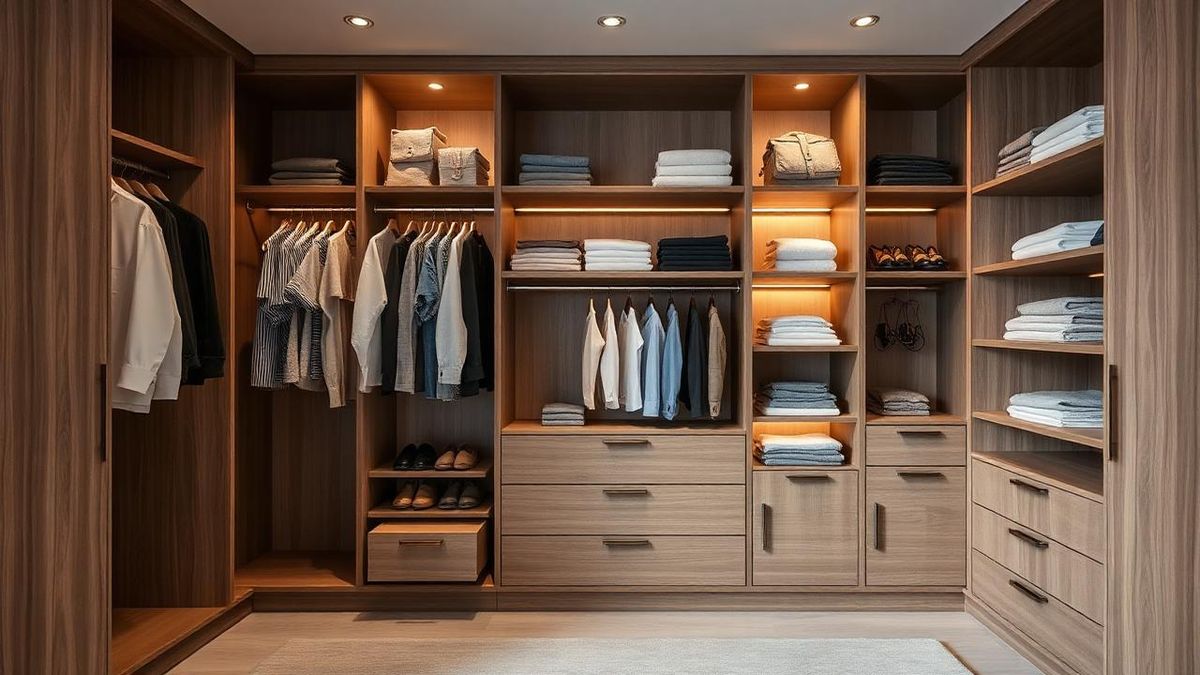
The way most people plan a wardrobe is the wrong way around
The default planning sequence in most Ghaziabad homes is: pick a shutter finish, pick a colour, then ask the manufacturer to fit "as much storage as possible" inside. This produces wardrobes that photograph well and frustrate daily.
The right sequence is: catalogue what you actually own, decide where it should sit, design the internals around that, then choose a shutter that fits the room. The internals are what you live with. The shutter is what guests see.
This article walks through the planning sequence in the order that actually matters.
Step 1 — Match the layout to your room
Four wardrobe layouts cover essentially every Ghaziabad bedroom.
Hinged wardrobe
Best when: standard rectangular bedroom, full access to the wardrobe wall, no obstacles within 60cm of the wardrobe face.
What it looks like: 2–4 hinged shutters opening outward, full visibility of internals when open, easiest access to deep drawers and pull-outs.
Strengths: Cheapest of the four. Best internal accessibility. Soft-close hinges are mature, reliable, and easy to service. The only layout where you can see the entire wardrobe contents in one glance.
Weakness: Needs swing-out clearance — about 60cm in front of each shutter. Doesn't work in narrow rooms or where the bed sits close to the wardrobe wall.
Cost in Ghaziabad: ₹55,000–1,40,000 for a 6–8 foot hinged wardrobe.
Sliding wardrobe
Best when: narrow bedroom, bed close to wardrobe wall, or a long wardrobe (8+ feet) where hinged shutters become unwieldy.
What it looks like: 2–4 shutters that slide along an upper and lower track, no swing clearance needed.
Strengths: Zero swing space. Can be very wide (up to 12+ feet). Visually quieter than hinged shutters because the surface is uninterrupted.
Weakness: At any given moment, you can only access half (or two-thirds) of the wardrobe — the part the open shutters reveal. Sliding tracks need cleaning every 2–3 months to stay smooth. Track quality varies enormously; cheap tracks bind within 2 years.
Cost in Ghaziabad: ₹85,000–2,20,000 for a 6–9 foot sliding wardrobe. Tracks alone add ₹8,000–25,000 to the comparable hinged version.
Walk-in wardrobe
Best when: dedicated dressing room or alcove of at least 5×7 feet, attached to a master bedroom or bathroom.
What it looks like: An open or partially-shuttered storage room you walk into, typically with hanging on two walls, drawers and shelves on the third, and an optional dressing island in the centre.
Strengths: Maximum visibility. Best for couples (clear separation of his/her sides). Open shelving with curtain or glass shutters costs less than fully shuttered storage.
Weakness: Needs the room. Requires good ventilation to prevent mustiness in monsoon. Open shelves need disciplined organisation — visible clutter is unforgiving.
Cost in Ghaziabad: ₹2,00,000–6,00,000 depending on size and finish.
Floor-to-ceiling wardrobe
Best when: any of the above layouts in a high-ceiling Ghaziabad apartment (9.5–10 ft ceilings, common in newer construction).
What it looks like: Wardrobe extends from floor to ceiling, with an upper "loft" section accessed via step stool for monthly-access items (extra blankets, suitcases, seasonal clothing).
Strengths: Adds 25–35% storage capacity at modest cost. Visually anchors the room. Eliminates the dust-collecting gap between top of wardrobe and ceiling.
Weakness: Top section requires a step stool. Slightly more material cost — typically 10–15% premium over standard-height wardrobe.
This isn't really a separate layout — it's an upgrade on hinged, sliding, or walk-in. For most Ghaziabad bedrooms, it's the highest-value upgrade in the spec sheet.
Step 2 — Plan the internals around what you own
Walk to your current wardrobe right now. What's actually in it?
For most Ghaziabad households, the answer is a mix of:
- Long-hang items: sarees, kurtas, formal shirts, lehengas, suits — need 100–110cm hanging height
- Short-hang items: shirts, blouses, dresses, t-shirts on hangers — need 80–90cm hanging height
- Folded items: jeans, sweaters, casual tops, kurta-pyjama sets, towels — go on shelves
- Drawer items: undergarments, socks, accessories, belts, scarves
- Special storage: jewellery, watches, ties, sunglasses, handbags, shoes (sometimes)
- Heavy seasonal: quilts, blankets, suitcases, off-season clothing — go to top loft
A well-planned wardrobe assigns dedicated zones to each. A poorly-planned one has hanging rods full of half-folded jeans that ought to be on shelves.
A good internal layout for a typical Ghaziabad master bedroom (8 ft wide, 7 ft tall hinged wardrobe):
| Zone | Width | Contents |
|---|---|---|
| Long-hang section | 2.5 ft | Sarees, kurtas, formal wear |
| Short-hang + drawer below | 2.5 ft | Shirts/dresses on top, drawers (jeans, t-shirts) below |
| Open shelf stack | 1.5 ft | Folded daily wear, towels |
| Drawer column | 1.5 ft | Undergarments, socks, accessories, jewellery tray |
| Top loft (full width) | — | Suitcases, seasonal items |
Tweak proportions to match your actual contents. A homeowner who wears mostly western wear will want more short-hang and fewer long-hang. A homeowner with a heavy saree collection will want the opposite.
Step 3 — Spend on the things you touch every day
This is the section most homeowners get wrong. The hardware and internal fittings determine whether your wardrobe still feels good in year five. The shutter determines how it photographs in week one.
Spend more on:
Soft-close hinges and drawer channels. A budget hinge rated to 30,000 cycles will fail within 18 months of normal use. A premium German hinge (Hettich, Häfele, Blum) rated to 200,000+ cycles outlives the wardrobe. Drawer channels follow the same logic. The hardware upgrade adds ₹8,000–25,000 to a typical wardrobe and is the single most-felt difference between a good wardrobe and a great one.
Drawer depth and quality. A wardrobe with two shallow trays disappoints. A wardrobe with three deep drawers — at least 50cm front-to-back, with full-extension channels so you can see everything in the back — transforms daily use. Pay for full-extension over partial-extension channels.
A proper hanging rod system. A pull-down hanger rod (the kind that drops to face level when needed) is genuinely useful for tall wardrobes where the hanging rod sits above eye level. A double-rod system that fits short-hang on top and a row of folded items below maximises a 1m bay efficiently.
Internal LED lighting. A motion-sensor LED strip that turns on when the shutter opens costs ₹1,500–4,000 to add. It's the second-most-felt upgrade in a wardrobe — finding the right shirt at 6 AM in winter is dramatically easier with internal lighting.
Spend less on:
High-gloss acrylic shutters. A glossy wardrobe shutter shows fingerprints constantly. Matt laminate or matt acrylic looks better, costs less, and ages more gracefully.
Decorative handles. A simple recessed J-profile handle or push-to-open mechanism reads cleaner and avoids the dust-trap of ornate hardware.
Mirror inserts on every shutter. One full-length mirror is genuinely useful. Three are visually heavy and hard to keep clean. Add a mirror to the inside of a shutter (where it serves the dressing function) rather than to the outside.
Glass shutters. They look elegant in showrooms and reveal whatever clutter you have at home. Reserve glass for one display unit at most.
Step 4 — Choose a shutter that fits the room, not Pinterest
By this point, layout and internals are decided. The shutter is the visual finish.
For most Ghaziabad bedrooms, the right answer in 2026 is matt laminate or matt acrylic in one of these palettes:
- Walnut woodgrain laminate — warm, timeless, suits both modern and traditional rooms
- Warm grey or taupe matt — quiet, neutral, lets the room's other elements lead
- Sage green or olive matt — current 2026 palette, ages beautifully
- Cream or off-white matt — opens up small bedrooms, light and easy
Avoid:
- High-gloss anything (fingerprints, dates fast)
- Bold reds or navy on the full wardrobe (hard to live with after year three)
- All-mirror sliding fronts (cleaning nightmare, visually heavy)
- Decorative profile mouldings on shutter edges (dust traps)
Specific Ghaziabad considerations
Monsoon humidity and ventilation. Wardrobes against external north or west walls in Ghaziabad collect monsoon humidity. A 50mm air gap between the wardrobe back and the wall helps. So does running a small dehumidifier or moisture absorber inside the wardrobe during peak monsoon.
Carcass material matters more here than in dry cities. HDHMR 18mm or BWP marine plywood — never standard MDF. Ghaziabad humidity will swell MDF wardrobe bases within 3–5 monsoons.
Edge banding on every cut. Including hidden edges. This is the silent quality factor that determines whether your wardrobe still looks tight in year ten.
Carpenter-made vs modular. Modular wins for most Ghaziabad bedrooms — see our comparison piece for the full breakdown.
How ModuCrafts approaches wardrobes
Every wardrobe starts with a 30-minute conversation about what you actually own, in addition to the room measurement. The internal layout is designed around your contents, not generic templates. HDHMR 18mm carcass and PVC edge banding on all six surfaces are standard. Soft-close hardware is included from the Standard package upward — Hettich at Standard, Blum or Häfele at Premium. Internal LED lighting and pull-down hanger rods are available as straightforward upgrades, not vague "premium add-ons."
Ready to plan your wardrobe?
Talk to ModuCrafts about your bedroom storage.
Bring a list of what's actually in your current wardrobe — we'll design the internals around it before we talk shutters.
Plot 2A, Gangapuram Colony, Hapur Road, Ghaziabad – 201015 · Mon–Sat, 10 AM – 6 PM